

Case study 03 / Windows local web app
Atlas Reach
A dense Windows workspace with duplicate-aware imports, lead editing, local analytics, pagination, exports, and backups.
Conceptual artwork / product evidence follows

Product direction, interface, implementation, privacy boundaries, and release verification by Kirsten Trimaley.
I use AI to explore and accelerate, but I own the product decisions, the verification, and the responsibility for what ships.
- Release
- v1.3.0
- Data boundary
- Import in · Excel out
- Visual proof
- 4 isolated Edge states
The real product
Built to be used,
not just viewed.
A compact, local-first lead CRM for importing approved spreadsheets, managing sales activity, and exporting clean workbooks.
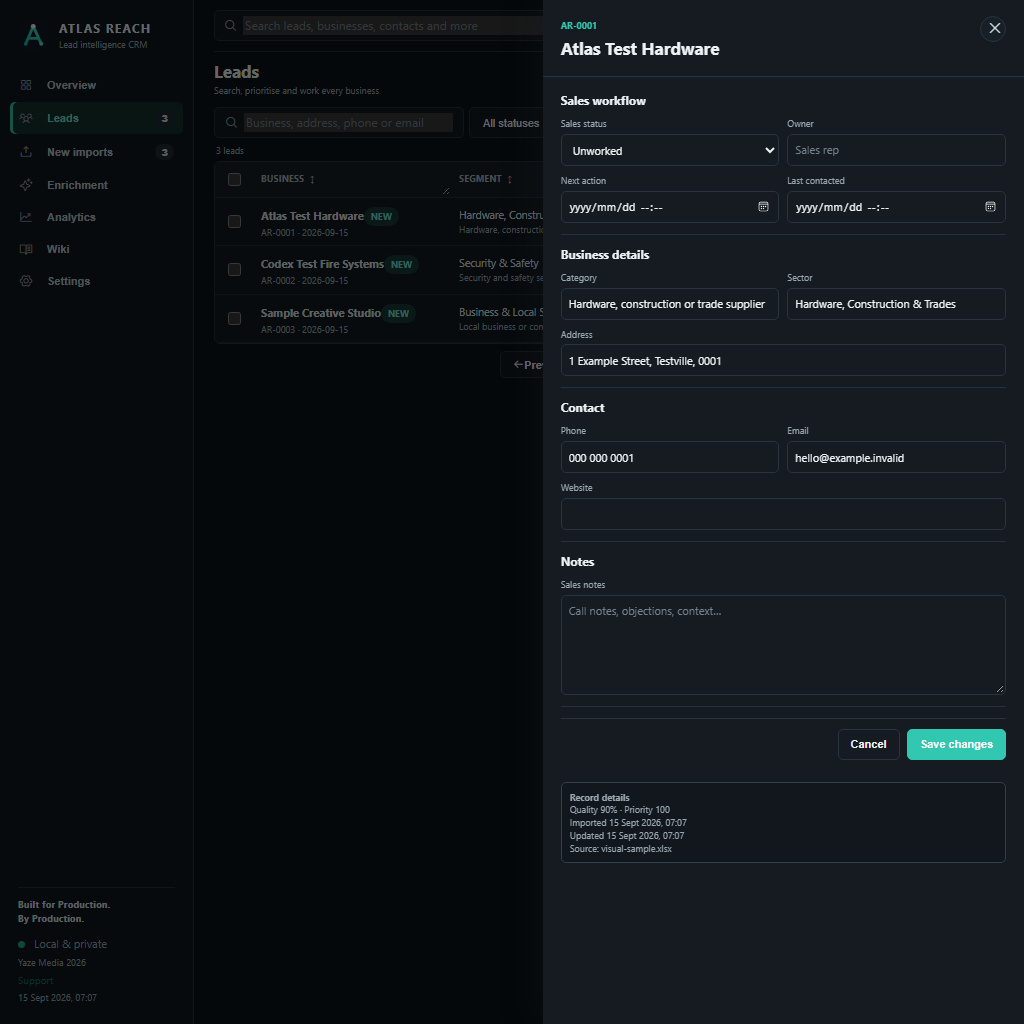
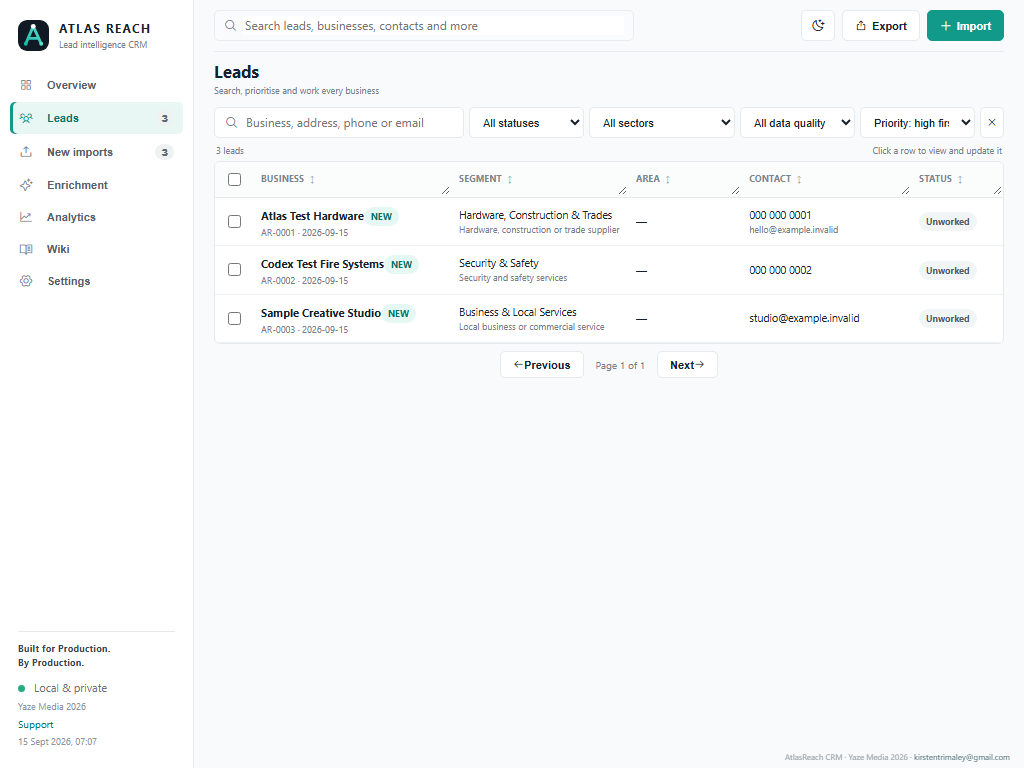
Complete application frame · source aspect ratio preserved · privacy-safe data
What I changed
- Reshaped the CRM into a compact, table-first workspace with a focused right-side editor and bounded pagination.
- Removed scraper integration and documented a strict file-import and Excel-export product boundary.
Boundaries first
- Operational data, imports, exports, browser profiles, and SQLite files stay off GitHub and on the operator's machine.
- The convenience sign-in is for a private workstation; the service listens only on 127.0.0.1 and is not multi-user security.
Decisions
- Use duplicate-aware spreadsheet merging and keep source history visible instead of hiding import provenance.
- Treat import and export as the only data boundary; no scraper controls, background scraping, telemetry, or cloud sync.
Proof of work
- The v1.3.0 release includes syntax checks, release-boundary checks, API and import regression coverage, and deterministic visual QA.
- The visual suite verifies light and dark lead tables plus right-side editor states with isolated synthetic records.
What comes next
Keep strengthening migration and recovery guidance while preserving the single-operator, local-first boundary.
Discuss a project